Technical debt used to be a thing that compound slowly. You’d make a suboptimal integration decision, and six months to a year later, when you tried to scale, you’d start feeling the pain. Over time there would be discussions and disagreements over how and when to prioritize the removal of the debt. The feedback loop was long enough that you could afford some indecision, some “we can get to it later” or “let’s see how it plays out.” Not anymore.
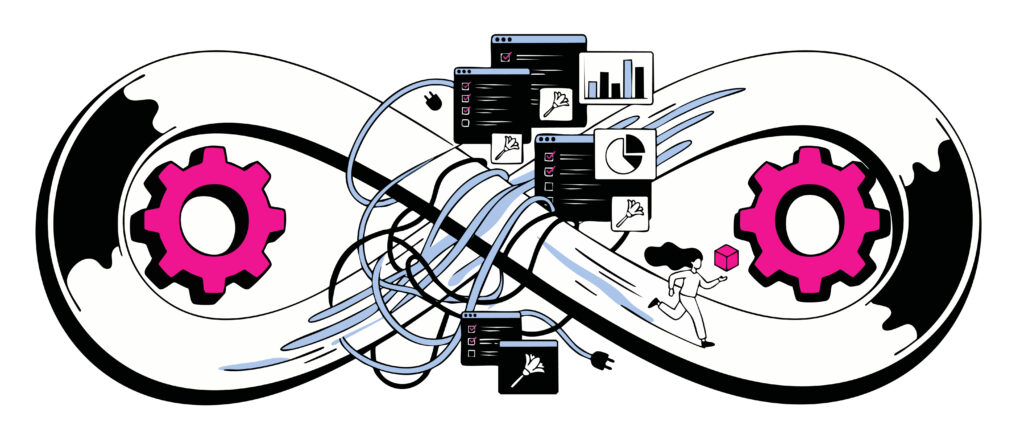
In the world of AI-driven systems, where code generation is trivial and iteration cycles are measured in hours, the cost of architectural indecision hits faster and harder. This week, in our little startup we killed a plan mid-flight. Not because the plan was bad, but because “good enough” would have locked us into fragmented truth at AI speed. When your iteration cycles shrink from weeks to hours, architectural friction doesn’t just slow you down … it compounds exponentially.
The original plan seemed logical. “Let’s gently introduce this new capability.” or “Let’s test this out on part of the platform.” But the migration plan had a fatal flaw: it would have created a hybrid truth model. Human teams would see tasks. Our agents would still federate truth from a separate programmatic source. Two sources of truth in a context sensitive world. Two potential points of divergence.
At enterprise scale, this looks like the classic “CRM says one thing, ERP says another” problem. Sales sees one customer record, finance sees a different version, and nobody trusts either. Except now, instead of reconciling quarterly, you’re reconciling daily, because your AI agents are shipping features that depend on that truth.
So … we pivoted to a programmatic truth model for both humans and agents. The migration, as planned, would have given us a visually unified surface but left the underlying architectural challenge unresolved. Cosmetic fix, not foundational.
We chose to federate our cross-repo truth model via inline-block sync to a canonical single source of truth. Our agents operate directly on canonical truth. This approach avoided the requirement for another translation layer, adding latency and increasing the risk of inconsistent states.
Another parallel is the “master data management” conversation every Fortune 500 has had. Do you build a pretty dashboard that hides the mess, or do you fix the data model? The difference: traditionally you might have had a year to get it right. In an AI-native startup, you have a week before that technical debt starts breaking builds.
Why Indecision Is More Expensive Now: The immediate pushback has always been predictable. As someone who was responsible for architecture I had heard all the reasons … “People had invested time.” “It feels like backtracking.” But today here’s what most leaders are missing: when your iteration cycles shrink from weeks to hours, architectural friction doesn’t just slow you down, it compounds exponentially.
Imagine debugging an AI agent’s unexpected behavior, only to discover the “truth” it operated on diverged from what a human team member was seeing. You’d burn engineering cycles chasing ghosts. You’d erode trust in autonomous systems. And because you’re shipping features daily, not quarterly, that friction hits your velocity immediately.
In traditional enterprise IT, a fragmented data model might take six months to bite you, long enough to defer or bandaid the decision, run a pilot, form a committee. In an AI-native environment, you’ll feel it in the next sprint. My lesson from large enterprise still applies: sometimes the hardest “no” is to a seemingly benign, incremental improvement that quietly digs you deeper into a hole. The difference now is that hole gets deeper, faster.
Code is no longer hard to produce. The bottleneck is architectural clarity. The cost of indecision, of letting “good enough” slide because killing a plan feels wasteful, is higher and comes quicker. Your leadership decision style needs to account for that compression. The six-month margin for error you had in traditional enterprise IT? In AI-native systems, it’s a week. The good news is code is cheap but good luck maintaining without that solid architecture and plan.